For quite some time I have been interested in the idea of running a fully self‑contained guitar and audio processing system on embedded hardware. Modern single‑board computers have become extremely capable, but turning them into reliable real‑time audio systems is still surprisingly complex.
That exploration eventually turned into a project that I am now releasing publicly:
PiPedal Linux by 1m2lab.
PiPedal Linux is an embedded Linux distribution designed to run the excellent PiPedal pedalboard host on dedicated hardware platforms.
The goal of the project is simple:
create a stable, reproducible, appliance‑style operating system for real‑time audio processing.
Acknowledging the PiPedal Project
Before going further, it is important to highlight the project that makes all of this possible.
PiPedal Linux exists to run the outstanding PiPedal software created by David R. Davies.
Project repository:
https://github.com/rerdavies/pipedal
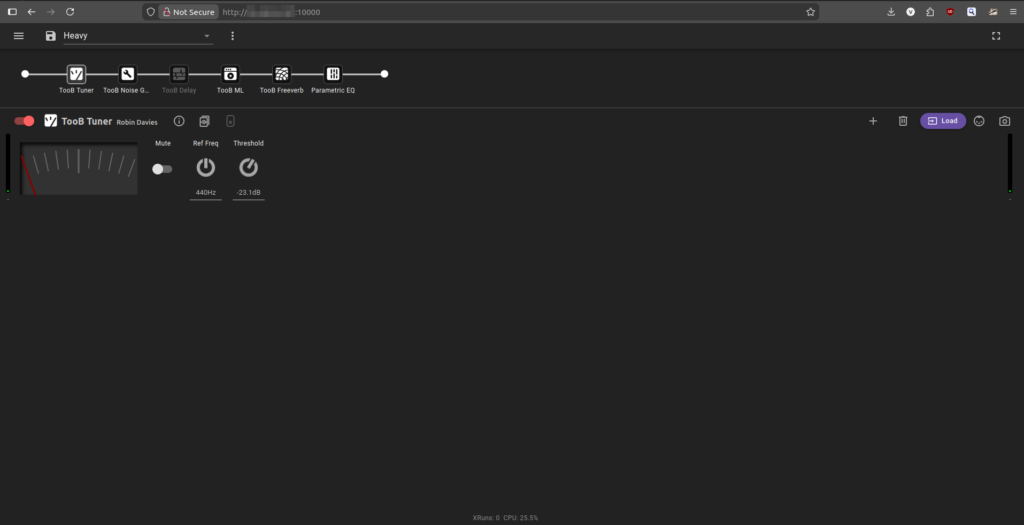
PiPedal is an extremely impressive open‑source project that provides:
- a browser‑based pedalboard editor
- LV2 plugin hosting
- flexible routing and patching
- pedalboard management
- remote control via web interface
In many ways it turns a Linux system into something that feels closer to a digital guitar processor or effects rack.
The PiPedal project is under active development and evolving rapidly.
Huge thanks to David R. Davies and all contributors for building such a powerful system and releasing it as open source.
PiPedal Linux is not a replacement for PiPedal — it is a platform designed specifically to run it well on embedded hardware.
Why an Embedded Distribution?
Running audio software on embedded hardware is possible today, but it often requires a lot of manual work.
Typical issues include:
- unpredictable real‑time latency
- unstable USB audio interfaces
- incorrect kernel configuration
- power‑saving features interfering with audio
- complex installation procedures
Even experienced Linux users may spend hours tuning a system before it becomes stable.
The idea behind PiPedal Linux is to remove that complexity.
Instead of configuring a system manually, the user simply:
- flashes an image
- boots the device
- opens the web interface
The system is ready to use.
Architecture of PiPedal Linux
PiPedal Linux is built on top of the Armbian build framework.
This allows the distribution to leverage a mature embedded Linux ecosystem while still maintaining full control over configuration and build reproducibility.
The system architecture looks roughly like this:
Hardware
↓
Armbian Linux
↓
Audio stack (ALSA / JACK / PipeWire)
↓
PiPedal
↓
LV2 Plugins
↓
Hardware UI (SATBUS / Widowmaker)
The distribution adds a thin layer on top of Armbian that focuses on:
- audio tuning
- provisioning
- appliance behaviour
- hardware integration
Real‑Time Audio Optimisation
A major focus of the project is ensuring stable low‑latency audio performance.
The system applies several optimisations automatically:
- real‑time scheduling configuration
- IRQ distribution tuning
- CPU governor set to performance mode
- USB autosuspend disabled for audio devices
- audio user permissions configured automatically
These changes are small individually, but together they make a large difference in reliability.
Provisioning and Appliance Behaviour
Another important goal is to make the system behave like a dedicated appliance rather than a generic Linux installation.
On first boot the system automatically performs provisioning tasks such as:
- configuring PiPedal
- installing required packages
- preparing plugin directories
- enabling services
The result is a system that feels closer to powering on a hardware effects unit than installing a Linux distribution.
System Dashboard (MOTD)
When logging into the system via SSH, a custom dashboard is displayed showing:
- PiPedal service status
- Web UI address
- system load
- temperature
- memory usage
- plugin counts
This provides a quick overview of system health and configuration.
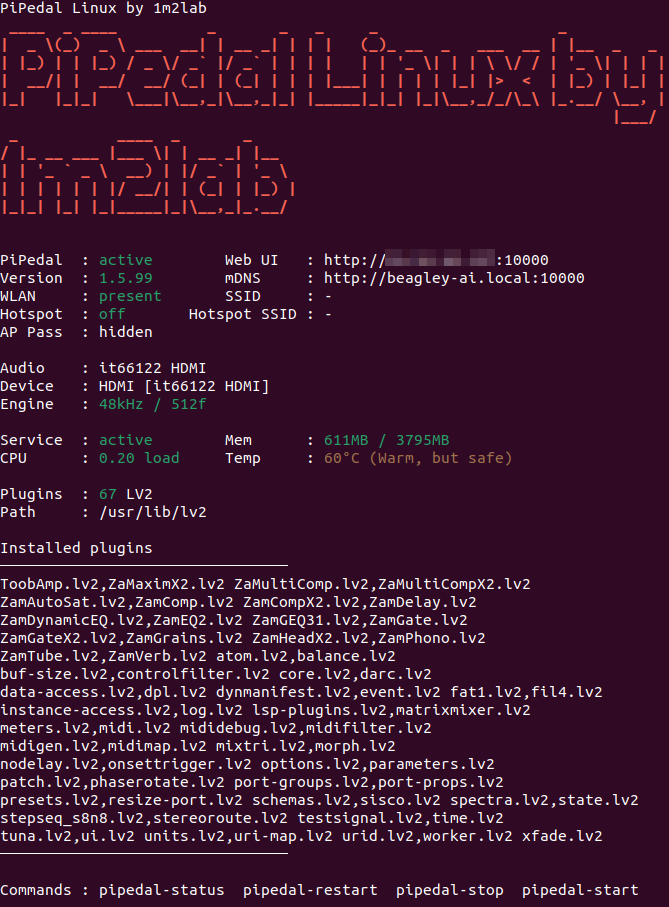
MOTD is simply one look interface. During installation on first boot SSH/console login is root:1234Supported Hardware
The initial development platform is:
BeagleY‑AI
This board provides a powerful ARM platform with good I/O capabilities and solid Linux support.
Future targets may include:
- Raspberry Pi
- Rockchip SBC platforms
- x86 mini PCs
The long‑term goal is to support multiple hardware platforms suitable for audio appliances.
Building the Distribution
The distribution can be built from source using the included build system.
Example:
./build.sh image beagley-aiThe build system integrates with the Armbian build environment and produces reproducible bootable images.
Open Source and Future Plans
PiPedal Linux is released as an open‑source project under the MIT License.
Future development may focus on:
- additional hardware platforms
- hardware control interfaces
- plugin ecosystem expansion
- turnkey embedded audio appliances
Final Thoughts
This project started as an experiment in building reliable embedded audio systems.
It has gradually evolved into something closer to a small Linux distribution focused on a very specific goal.
Most importantly, none of this would exist without the PiPedal project itself.
Once again, huge thanks to:
David R. Davies and the PiPedal contributors.
If you are interested in building guitar or audio processing systems on Linux, PiPedal is absolutely worth exploring.
And hopefully PiPedal Linux can help make that journey a little easier.
You can access the project here: https://anubis.1m2lab.engineer/1m2lab/pipedal-distro